
Working remotely while traveling Europe is something we have been figuring out for years. We spend around three months a year in Europe, a month in Puerto Rico, and have worked from Costa Rica too. We are not digital nomads in the traditional sense — we have a home base, real jobs, and East Coast hours to keep. But we have learned how to make extended travel work around a full schedule, and this post is everything we know about how to do it well.
If you are thinking about working remotely while traveling Europe, the good news is that it is more doable than you think. The bad news is that nobody tells you the stuff that actually matters — the wifi failures, the tiny kitchen tables, the Thursday afternoon you finally crack local hours and suddenly Europe feels like it was always yours.
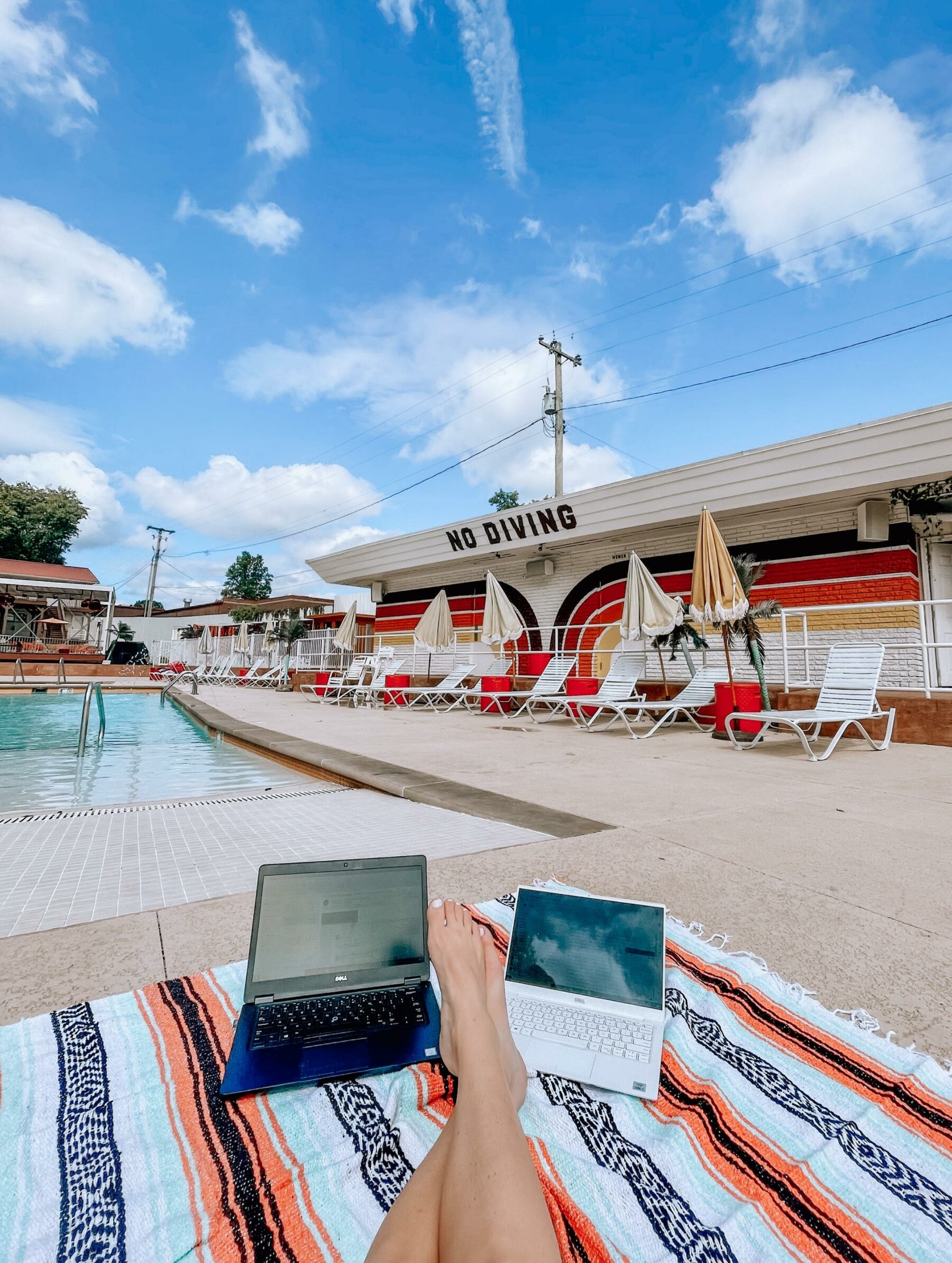
WHY WE WORK REMOTELY WHILE TRAVELING EUROPE
We are not trying to escape our jobs. We actually like what we do. What we wanted was to stop waiting for two-week vacations to see the world and start building a life where travel is just part of how we live. Working remotely while traveling Europe has made that possible.
The trick we figured out early: you do not need to take much time off to travel a lot. Take a Friday or a Monday off, work the other four days, and suddenly you have three full non-work days to explore instead of two. Stack a couple of those and you can do a meaningful trip to a new country without burning through your PTO. We have done weekend trips to Kotor from Split, day trips into the Swiss Alps from Thun, and mountain hikes above Lake Bled on a Tuesday morning before logging on.
OUR ACTUAL DAILY ROUTINE
Working remotely while traveling Europe on US East Coast hours sounds brutal, but the schedule actually works in your favor more than you would expect.
Mornings are completely ours. We are usually up and out the door by 8AM — walking the city, hiking, hitting the beach, or sitting at a market with a coffee before anyone back home has even opened their laptop. By the time the work day starts, we have already had more of a morning than most people get on a weekend.
We work from roughly noon or 1PM local time through to 9 or 10PM, with a break for dinner. That dinner break is one of our favorite parts of the day — stepping out of a small Lisbon apartment at 7PM to find a pastel de nata and a glass of wine, then coming back to finish the evening. It does not feel like a work dinner. It feels like living there.
On Thursdays and Fridays we try to shift to local hours when possible — starting earlier, finishing by 6PM. It makes the end of the week feel like an actual European weekend, and it is usually when we book dinners or plan something worth getting out for.
Pro Tip: Taking a Friday or Monday off instead of full weeks means you get three non-work days while only using one day of PTO. It is the single best travel hack we have found for people with real jobs.
THE BEST EUROPEAN CITIES FOR WORKING REMOTELY
We have worked remotely while traveling Europe from a lot of cities at this point — Florence, Split, Bratislava, Lisbon, Porto, Ljubljana, Lake Bled, Kotor, Annecy, Thun, Edinburgh, Malaga, Budapest, Valletta, Cagliari, Genoa, and Bologna. Here is what we have learned about which types of cities actually work best.

Cities Where You Can Walk to Clear Your Head
This matters more than we expected. Split and Kotor are two of our favorites for remote work not because of the coworking scene, but because you can walk out your door and be along the water in two minutes. A 20-minute morning walk along the Riva in Split or along Kotor’s bay walls resets your brain in a way that makes the afternoon work session genuinely better. Same logic applies to Annecy and Thun — being able to take a break and walk along an Alpine lake is not a small thing when you are six hours into a screen.
Read our full guide to things to do in Split, Croatia and our guide to Thun, Switzerland for more on the waterside cities worth basing yourself in.
Florence
Seth lived in Florence for over two years across various stays. It is one of our two favorite cities in the world, and it is an extraordinary place to base yourself for remote work. The food alone makes the long work days worth it — you are never more than a five-minute walk from the best sandwich or gelato of your life. The city is walkable, the neighborhoods feel genuinely local, and a morning in the Oltrarno before work will spoil you for life. Read our complete Florence city guide here.
Lisbon and Porto
Lisbon has become one of the most popular remote work cities in Europe for good reason — fast wifi, good weather most of the year, great food, and a cost of living that is still reasonable compared to Western European capitals. Porto is smaller, quieter, and in our opinion even more charming for a longer stay. Both are excellent bases. Read our guides to things to do in Lisbon and things to do in Porto.
Bratislava and Budapest
These two often get overlooked and they should not. We have made lasting friendships in Bratislava — it has that quality of a city small enough that you actually become a regular somewhere within a week. Budapest is larger and has more going on, but both are affordable, central, and easy bases for exploring Central Europe on weekends. Read our Budapest guide here.
WHERE WE ACTUALLY WORK FROM
Honestly? Almost always our apartment. We rent on Airbnb specifically looking for good wifi, a real desk or table, and natural light. We are not coworking space people — the monthly cost adds up fast and we would rather spend that on food and experiences. The apartment setup lets us treat a city like home, not like a hotel stay.
When we need a change of scenery we will pop into a cafe or, if we are somewhere like Split or Kotor, find a spot along the water with decent signal. Some of the best work sessions we have had were at a table outside with a view of the Adriatic. It does not take much to make a Tuesday afternoon feel completely different when the backdrop changes.
Pro Tip: When searching Airbnb, filter for “dedicated workspace” and check recent reviews specifically for wifi mentions. Do not trust the listing speed — ask the host directly and request a speed test screenshot if you are staying more than a week.
OUR REMOTE WORK GEAR SETUP
We both travel with a portable monitor. This single item has changed how sustainable long-term remote work travel is for us. We are used to multi-monitor setups at home and trying to work from a single laptop screen for weeks at a time is genuinely fatiguing. A travel monitor packs flat, weighs under a kilogram, and connects via USB-C. It is the closest thing to replicating your home setup that we have found.
Beyond that: laptop, a good power strip with international adapters, noise-cancelling headphones for calls when the apartment has thin walls, and an eSIM. For remote work gear that actually travels well, read our full remote work essentials guide here.
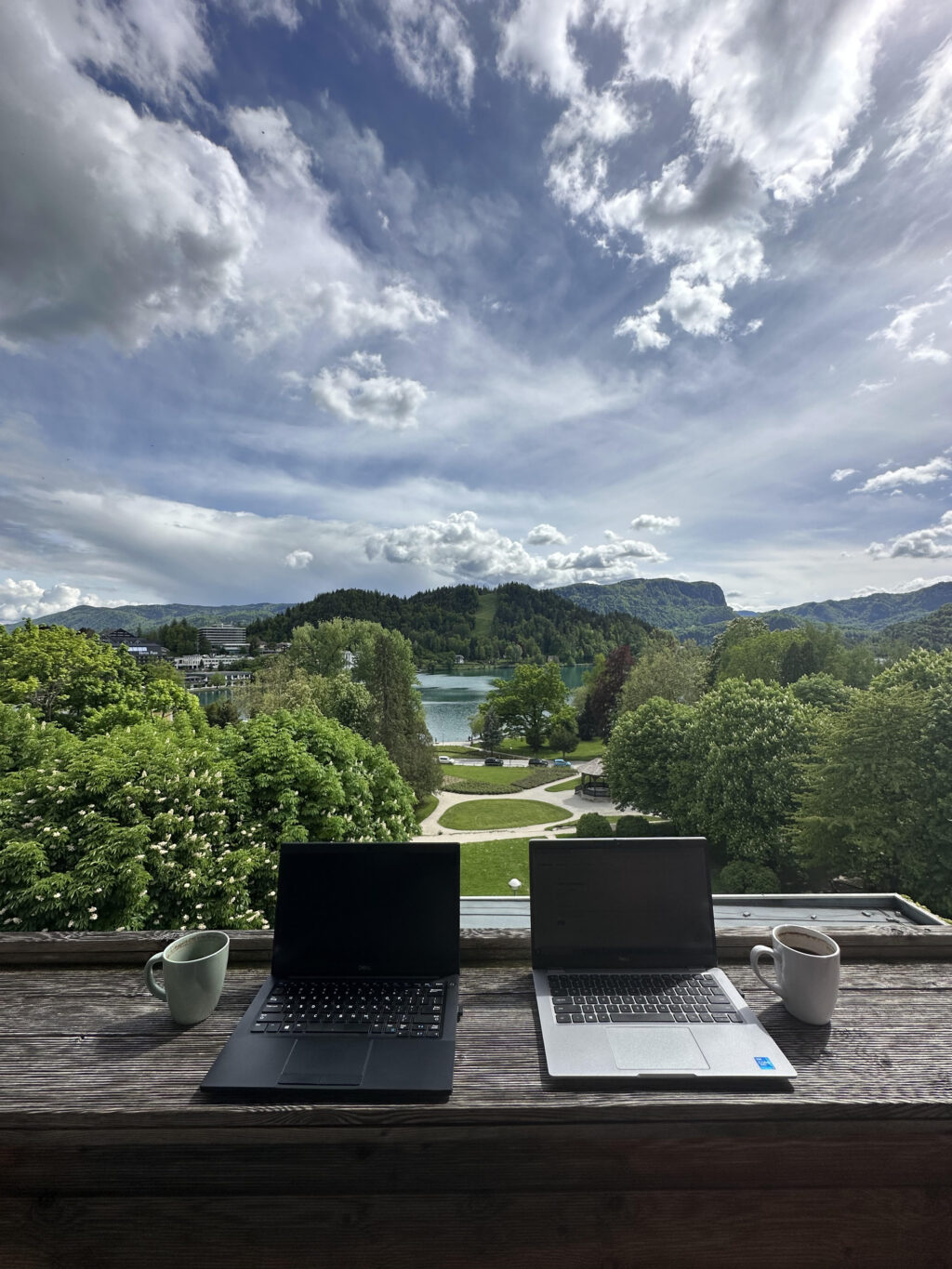
STAYING CONNECTED: WIFI AND ESIM
Wifi is the thing that keeps you up at night when you are working remotely while traveling Europe. We have lost power for an entire day in Puerto Rico. We have had Airbnbs with listed “fast wifi” that turned out to be unusable. It happens, and you need a backup plan before you need it.
Our solution is always an eSIM with enough data to hotspot through a full work day if necessary. We use Saily as our primary — use code THEJETLAGJOURNEY25 for 25% off. Airalo (code JLJ10 for 10% off) is a solid backup. Between the two we have never been fully without a connection when it mattered. Read our full guide to international phone plans here.
THE HONEST CHALLENGES
Working remotely while traveling Europe is not all aperitivo and Adriatic sunsets. Here is the real version.
The Ergonomics Are Not Great
We both have proper desks, good chairs, and multiple monitors at home. On the road, we are often crammed across from each other at a small kitchen table, necks at slightly wrong angles, fighting over the one good outlet. The portable monitors help. A small laptop stand helps. But it is still not the same, and after three or four weeks your body knows it.
Then you step outside to get a sandwich in Bologna or walk five minutes to the Split waterfront and remember why you are doing it. Worth it every time.
The Unknown
You can research a city’s wifi reputation, read every review, message the host three times — and still end up with a bad connection on a day you have back-to-back calls. The eSIM backup handles most of this, but the unpredictability of remote work travel is real. The more trips you take the better you get at reading the signals early and troubleshooting fast.
The Late Nights
Working until 9 or 10PM on East Coast hours means European dinner culture is slightly at odds with your schedule midweek. You will miss some early evening things. You will occasionally finish a call and realize the restaurant you wanted is fully booked. Thursday and Friday local hours help a lot — we protect those when we can.
PLANNING YOUR REMOTE WORK TRIP TO EUROPE
The planning side of working remotely while traveling Europe deserves its own section because it is where most people get tripped up. Schengen rules, visa lengths, and figuring out where to base yourself across a 90-day window are genuinely complicated.
We built our Travel Planner specifically for this — it has a built-in Schengen tracker, real cost-of-living data for 78 cities, and a city comparison tool so you can actually make informed decisions about where to base yourself and for how long. For a broader planning starting point, read our guide on how to plan a trip to Europe and our 3 months in Europe budget breakdown.

ETIAS: WHAT AMERICAN REMOTE WORKERS NEED TO KNOW
From Q4 2026, American travelers will need ETIAS authorization before visiting Europe. It takes about 10 minutes to apply and costs €20. If you are planning an extended remote work trip, sort this before you book anything. Read our complete ETIAS guide here.
FREQUENTLY ASKED QUESTIONS
Is working remotely while traveling Europe legal?
For most Americans working for a US-based employer, yes — you are working for a foreign company and not taking a job from a local. Schengen rules limit tourist stays to 90 days in any 180-day period, so you need to track your days carefully. Some European countries now offer dedicated digital nomad visas for longer stays. Always verify with your employer’s HR or a tax professional for your specific situation.
What is the best city in Europe for working remotely?
It depends on what you need. Lisbon and Porto offer great weather, affordable costs, and excellent infrastructure. Split and Kotor are perfect if you want coastal access and the ability to decompress with a walk along the water. Florence is exceptional for culture and food. Bratislava and Budapest are underrated and very affordable. Our full guide to the best European cities for digital nomads covers 10+ cities in detail.
How do you handle wifi reliability when working remotely in Europe?
We always travel with an eSIM loaded with enough data to hotspot through a full work day. We use Saily (code THEJETLAGJOURNEY25 for 25% off) as our primary and Airalo (code JLJ10 for 10% off) as a backup. When booking accommodation, we filter for dedicated workspace, check recent reviews for wifi mentions, and message hosts directly for a speed test if staying more than a week.
What gear do you need to work remotely while traveling Europe?
The single most impactful item is a portable travel monitor — it replicates your dual-screen home setup and makes multi-week trips genuinely sustainable. Beyond that: laptop, universal power strip, noise-cancelling headphones, and a loaded eSIM. See our full remote work travel essentials list for specifics.
How do you manage East Coast work hours in Europe?
We treat mornings as ours — walking, hiking, or exploring before we log on around noon local time. We work through to 9 or 10PM with a dinner break. On Thursdays and Fridays we shift to local hours when possible. The schedule is not for everyone, but the free mornings in places like Florence or Split make it a very fair trade.
How much does it cost to work remotely in Europe for a month?
It varies significantly by city. Lisbon and Split run roughly €2,000–3,000/month for a couple including accommodation, food, and activities. Bratislava and Budapest come in lower. Zurich or Paris will be considerably more. Our 3 months in Europe budget post breaks this down in detail, and our Travel Planner has real cost data for 78 cities to help you plan.
SAIL WITH US: VOYAGE BY THE JET LAG JOURNEY
We started Voyage after doing Yacht Week a couple of times and realizing we wanted something different — a sailing trip that actually let you experience the places you were visiting, not just party through them. Voyage is our boutique sailing trip through some of the most stunning waters in the world: the Greek islands, the Croatian coast, the BVI, and Italy. Think beautiful anchorages, local dinners, themed nights on the water, and a flexible itinerary that moves at the group’s pace — stay longer at a swim stop, get to an island early, make it yours. Groups are kept intentionally small so everyone knows everyone by day two. Find out more and sail with us →
SAIL WITH US: VOYAGE BY THE JET LAG JOURNEY
We started Voyage after doing Yacht Week a couple of times and realizing we wanted something different — the parties, yes, but also the culture, the food, the places, and actually being able to enjoy the next day. So we built it ourselves. Voyage is our boutique sailing trip through the Mediterranean — Greece, Croatia, Italy, BVI, and growing. Think stunning anchorages, themed nights, local dinners, and a loose itinerary that bends around the group. Stay longer at a swim stop, get to an island early, make it yours. We party, we explore, we recover — and groups are small enough that everyone knows everyone by day two. Sail with us →