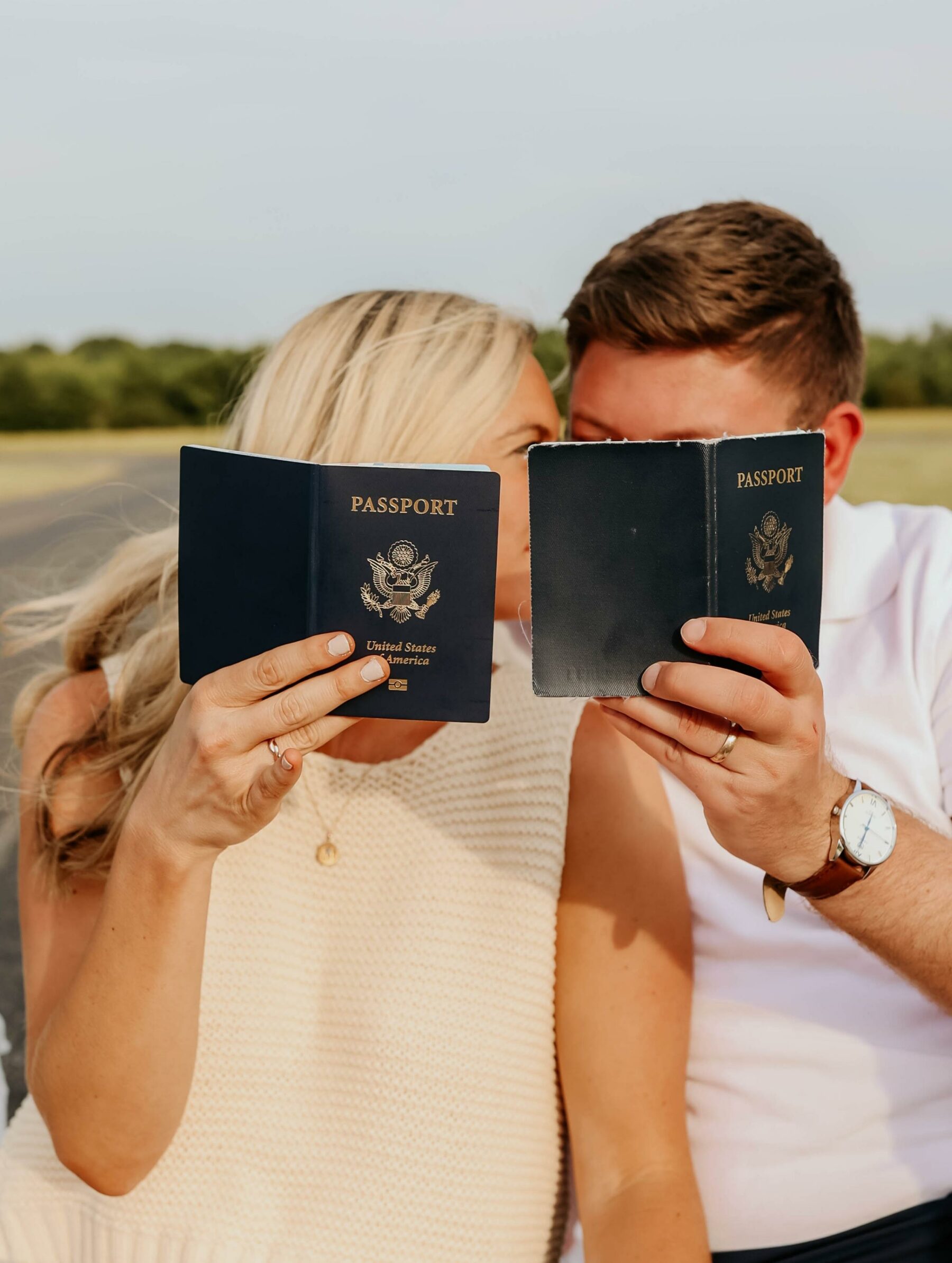
Munich is one of our favourite cities in Europe and a place Seth has been returning to for years. The things to do in Munich go far beyond Oktoberfest — though Oktoberfest deserves everything said about it. Seth has attended all three of Munich’s major beer festivals: Oktoberfest, Starkbierzeit (Strong Beer Fest), and Springfest. Springfest is his favourite. He has been to Oktoberfest six times, twice with Maddy, and it usually falls around his birthday. On our last visit the entire tent sang happy birthday to him — and because it was early and the tent was not yet full, security mistook his celebration for chugging (which is not allowed) and removed him. A hat seller and a pretzel vendor who had witnessed the whole thing came to his rescue and talked security around. That is Munich. That is Oktoberfest. There is nowhere else like it.
This complete guide covers everything — the beer festivals, the best restaurants and breweries, the top things to do in Munich, and the bike tour of the city that always ends at our happy place in the English Garden.
BEST TIME TO VISIT MUNICH
Munich has three major beer festivals and the time of year you visit shapes the entire trip. Here is how they break down.
Springfest — held in late April and early May on the Theresienwiese (the same grounds as Oktoberfest), Springfest is Seth’s favourite of the three. Smaller, more local, and with a more relaxed atmosphere than the tourist-heavy Oktoberfest. If you can only go to one beer festival, this is the one we would recommend for a more authentic experience.
Starkbierzeit (Strong Beer Fest) — held in March at the Paulaner brewery on the Nockherberg. A local institution celebrating the stronger Märzen-style beers traditionally brewed by Bavarian monks for Lent. More intimate than Oktoberfest and beloved by locals.
Oktoberfest — the most famous beer festival in the world runs for 16 to 18 days from late September through the first weekend of October. Seth has been six times and we have been twice together. If it falls around your birthday, there is a reasonable chance the tent will sing to you. It is chaotic, enormous, expensive, and absolutely worth experiencing at least once. Book accommodation months in advance — the city fills up completely.
Outside of festival season, May through September is the best general time to visit for weather and outdoor biergarten season. The English Garden is at its best in summer and the city is extremely lively.
HOW TO GET TO MUNICH
Munich Franz Josef Strauss Airport (MUC) is one of the best-connected airports in Germany with direct flights from most US cities and throughout Europe. The S-Bahn train from the airport to Marienplatz in the city center takes about 40 minutes and runs every 10 minutes.
By train, Munich connects directly to Vienna (4 hours), Salzburg (1.5 hours), Innsbruck (2 hours), and Zurich (3.5 hours). The main station (Hauptbahnhof) is central and very well connected to the U-Bahn network.
Pro Tip: Grab an eSIM before you leave home so you have data the moment you land. Saily is our go-to — use code THEJETLAGJOURNEY25 for 25% off. Airalo is a great alternative (code JLJ10 for 10% off).
CURRENCY AND TIPPING IN MUNICH
Munich uses the Euro. Card payments are accepted in most places but Germany still skews cash-heavy compared to other Western European countries — carry some Euros, especially for markets, smaller restaurants, and beer festivals. At beer festivals, cash is often the only option at some stalls. Tipping is appreciated but not as expected as in the US — rounding up the bill or leaving 10 percent at a sit-down restaurant is standard.
WHERE TO STAY IN MUNICH
The city center around Marienplatz and the Altstadt puts you within walking distance of the main sights, the best beer halls, and excellent transport links. For Oktoberfest visitors, staying anywhere near the Theresienwiese is convenient but books up impossibly fast — start looking as soon as the festival dates are announced.
Luxury: Hotel Bayerischer Hof in the Altstadt — one of the great grand hotels of Germany.
Mid-range: Look for hotels in the Schwabing or Maxvorstadt neighbourhoods for good value and a more local atmosphere.
Budget: Wombats City Hostel near the Hauptbahnhof is one of the best-run budget options in the city. For Oktoberfest season, consider the official festival campsite about 4 miles from the centre — book well ahead and bring cash for arrival.
WHERE TO EAT IN MUNICH
Bavarian food is hearty, honest, and deeply satisfying — pretzels, white sausages (Weisswurst), pork knuckle (Schweinshaxe), and sauerkraut done properly are all excellent here. These are the restaurants and beer halls worth your time.
Hofbräuhaus — the most famous beer hall in the world, steps from Marienplatz. Enormous, loud, and a genuine Munich institution. Every visitor should go at least once. Go for the experience and the atmosphere as much as the food.
Ratskeller München — traditional Bavarian cuisine in a beautiful vaulted cellar restaurant right in the city center under the Rathaus. One of the best settings for a proper Bavarian meal.
Augustiner Bräustuben — a Bavarian staple near the Hauptbahnhof and the place we always point people to for Starkbierzeit. Excellent food and some of the best Augustiner beer you will find anywhere.
Zum Franziskaner — centrally located near Marienplatz and the best place in Munich to try Schweinshaxe (pork knuckle). It is in Seth’s top three favourite foods to exist anywhere in the world and the version here is exceptional. Order it.
Chinese Tower Biergarten, English Garden — not a restaurant but the place we always end up. The biergarten around the Chinese Tower in the heart of the English Garden is our happy place in Munich. Self-service, enormous, under the trees, with polka music playing and steins being handed over by the thousand. We rent bikes, Seth takes us on a historical tour of the city, and we always end here. On a warm afternoon there is nowhere better in Munich.
WHERE TO DRINK IN MUNICH
Munich’s six original breweries are the foundation of the city’s drinking culture and bouncing between them is our preferred way to spend an evening. Each has its own character, its own beers, and its own atmosphere.
Augustiner-Keller — our favourite of the six. Augustiner is the oldest Munich brewery still independently owned and the beer is outstanding. The garden here holds 5,000 people and is magnificent in summer.
Hofbräukeller — the neighbourhood version of the famous Hofbräuhaus, with a more local crowd and a beautiful biergarten.
Paulaner am Nockherberg — the home of Starkbierzeit and one of the most important brewery destinations in Munich. The strong Salvator beer served here in March is extraordinary.
Löwenbräukeller — a grand beer palace near the Hauptbahnhof with a large beer garden and a beautiful interior hall.
Spatenhaus an der Oper — right next to the National Theatre on Max-Joseph-Platz. A more refined setting for a Bavarian beer and meal after an evening at the opera.
Hacker-Pschorr am Eisbach — a more modern bar and lounge near the city center that offers a change of pace from the traditional beer halls.
BEST THINGS TO DO IN MUNICH
The things to do in Munich go well beyond the beer festivals — though they are a very good place to start. These are the experiences we recommend to everyone.
Rent Bikes and Tour the City — the best way we have found to see Munich is on two wheels. Rent bikes and use the city’s excellent cycling infrastructure to move through the neighbourhoods, past the main historical sites and monuments, and end in the English Garden. Seth has taken groups and friends on his version of a historical cycling tour of Munich more times than he can count and it always ends at the Chinese Tower Biergarten. It is the perfect afternoon in Munich.
The English Garden — one of the largest urban parks in the world, bigger than Central Park in New York. The Chinese Tower Biergarten, the Japanese Tea House, the Monopteros temple with views over the city, and the Eisbach — a fast-moving artificial river channel where surfers ride a standing wave year-round. The surfers at the Eisbach are an extraordinary sight and one of the most uniquely Munich things you will see anywhere.
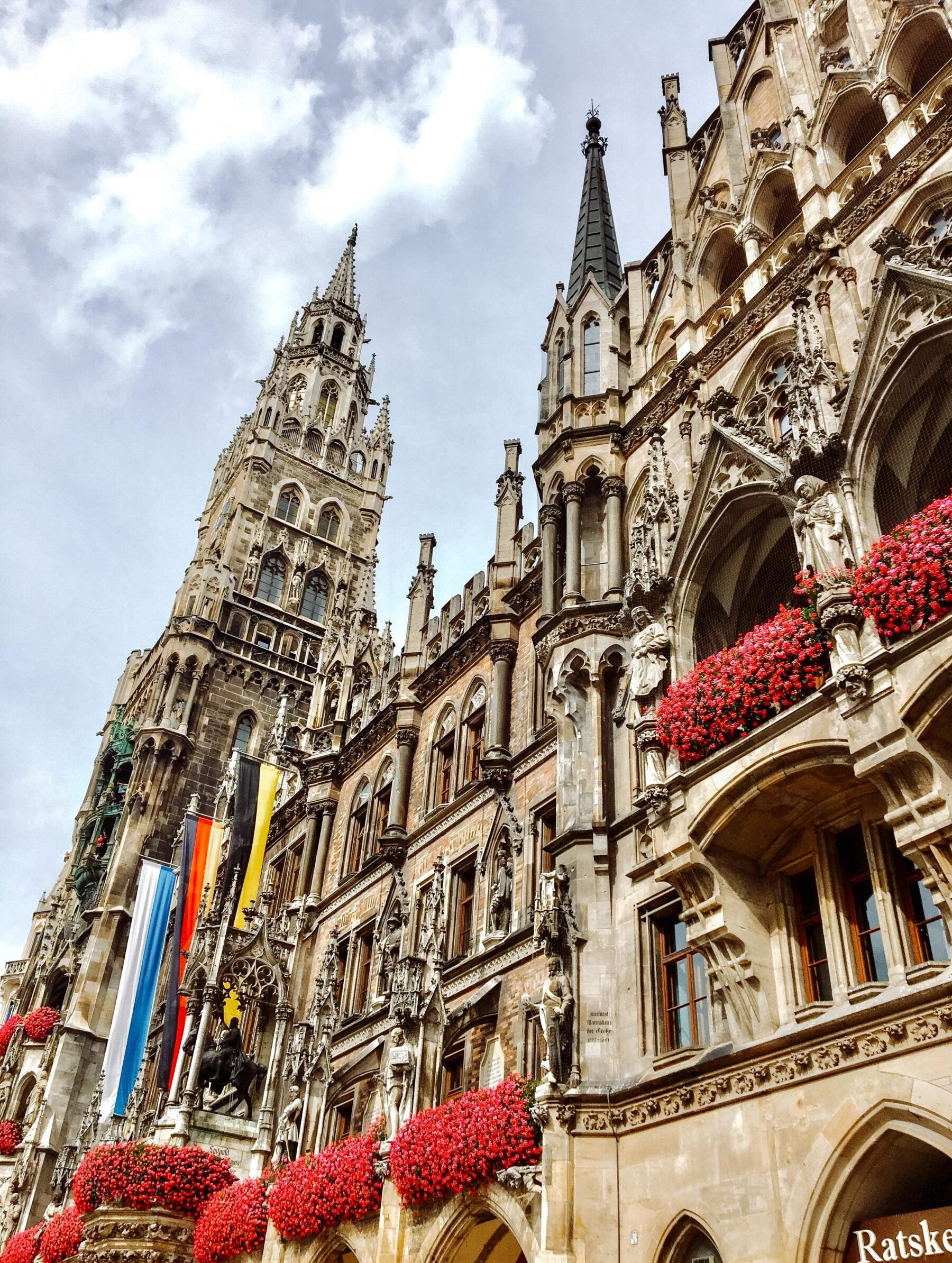
Marienplatz and the Neues Rathaus — the heart of the old city and the starting point of any walk through Munich. The Glockenspiel chimes at 11am, noon, and 5pm with a mechanical procession of figures re-enacting scenes from Munich’s history. Climb the tower for panoramic views over the Altstadt.
Viktualienmarkt — Munich’s daily open-air food market, a short walk from Marienplatz. Fresh produce, cheese, meats, flowers, and a central biergarten where you can drink a Masskrug while browsing. One of the great daily markets in Europe.
Deutsches Museum — the largest science and technology museum in the world, on an island in the Isar River. Extraordinary exhibits covering aviation, mining, marine technology, and dozens of other fields. Allow a full day.
BMW Welt and Museum — for anyone interested in cars or design, the BMW World showroom and adjacent museum are genuinely impressive. Free to enter the showroom, ticketed for the museum.
Nymphenburg Palace — the Baroque summer palace of the Wittelsbach royal family on the western edge of the city. The palace grounds are extensive and beautiful, especially in summer. Well worth the short tram ride from the center.
BEST DAY TRIPS FROM MUNICH
Neuschwanstein Castle — the fairy-tale castle that inspired Disney’s Cinderella Castle, about two hours by train and bus. Book tickets well in advance — it is one of the most visited sites in Germany.
Salzburg, Austria — 1.5 hours by train and a beautiful city in its own right. The birthplace of Mozart, a stunning Baroque old town, and the hills made famous by The Sound of Music.
Dachau Memorial — 30 minutes by S-Bahn, the site of the first Nazi concentration camp is a sobering and important visit. Free entry, guided tours available.
The Bavarian Alps — Garmisch-Partenkirchen is about 90 minutes by train and offers access to the highest peak in Germany, the Zugspitze, as well as hiking, skiing, and dramatic mountain scenery.
GETTING AROUND MUNICH
Munich’s U-Bahn and S-Bahn network is excellent — clean, punctual, and covers the entire city and airport. Buy a day pass for unlimited travel if you are moving around a lot. The city center is also very walkable and cycling is strongly recommended. Bolt works well in Munich for rideshare.
ETIAS — WHAT AMERICAN TRAVELERS NEED TO KNOW
From late 2026, American travelers will need ETIAS authorization before visiting Europe, including Germany. It takes around 10 minutes to apply and costs €20. Read our complete ETIAS guide for everything you need to know before your trip.
FREQUENTLY ASKED QUESTIONS ABOUT THINGS TO DO IN MUNICH
Is Oktoberfest worth going to?
Absolutely — at least once. Seth has been six times and it never loses its energy. The scale, the atmosphere, the music, the food, and yes, the beer are all unlike anything else in the world. Go with a group, dress in traditional Bavarian clothing (dirndl or lederhosen), get to the tent early if you want a seat, and be prepared for a long and memorable day. Book accommodation months in advance.
What is the best beer festival in Munich?
Seth’s favourite is Springfest — smaller and more local than Oktoberfest with the same grounds and a genuinely brilliant atmosphere without the overwhelming tourist numbers. Starkbierzeit in March at the Paulaner brewery is also excellent for a more traditional experience. All three are worth going to if you can time it right.
How many days do you need in Munich?
Three to four days covers the main things to do in Munich comfortably — the English Garden, the beer halls, Marienplatz, the Deutsches Museum, and a day trip. During a beer festival you could easily spend a full week and not run out of things to do.
What is Schweinshaxe and where should I try it?
Schweinshaxe is roasted pork knuckle — crispy skin, tender meat, served with sauerkraut and bread dumplings. It is one of the great dishes of Bavarian cuisine and Seth’s top recommendation for what to eat in Munich. Zum Franziskaner near Marienplatz does it as well as anywhere in the city.
What is the English Garden in Munich?
The English Garden is one of the largest urban parks in the world — bigger than Central Park in New York. It has a Chinese Tower biergarten, a Japanese Tea House, a Greek temple with views over the city, and the Eisbach, where surfers ride a permanent standing wave year-round. It is our happy place in Munich and the destination of every bike tour we do in the city.
Is Munich safe?
Munich is one of the safest large cities in Europe. The main thing to be aware of during beer festival season is petty theft in crowded areas and knowing your limits — the beers are served in one-litre steins and are strong. Beyond that, Munich is an extremely easy and welcoming city to visit.
MORE FROM THE JET LAG JOURNEY
Munich pairs brilliantly with Prague and Budapest on a Central European trip — read our Prague city guide and Budapest city guide for everything you need. Planning a bigger European trip? Our guide to how to plan a trip to Europe covers all the logistics. For more on managing costs, read our 40 ways to travel cheaper. And if you are planning an extended stay, our Nomad Planner has cost-of-living data for 78 cities across Europe.